
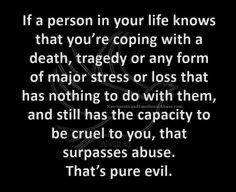
There is a peculiar kind of darkness in those who, despite witnessing another’s suffering, still choose to wield cruelty as their weapon. This is not the impulsive cruelty of survival, nor the mindless evil of ignorance, but something more deliberate, more insidious, the conscious decision to inflict harm, fully aware of its weight. It is a darkness that stems not from a lack of understanding, but from the refusal to care.
To see another in pain and proceed with cruelty is to engage in a form of moral corruption that goes beyond simple malice. It requires the suppression of empathy, the numbing of whatever conscience might stir in response to suffering. It is the cold calculation of a mind that has decided—whether out of resentment, power, or sheer indifference—that another’s pain is either inconsequential or, worse, deserved. In this sense, cruelty is not just an act but a mindset, a philosophy of negation that denies the dignity and humanity of another.
Nietzsche’s concept of ressentiment offers insight into this kind of darkness. He describes it as the poisoned worldview of those who feel powerless, who, rather than striving for greatness, seek instead to drag others down. It is the mark of a soul that cannot elevate itself and so takes satisfaction in the suffering of others, as though reducing another could somehow compensate for their own inadequacies. This is the cruelty of those who lash out not because they are strong, but because they are weak—because they cannot bear the existence of anything that does not share in their misery.
But this darkness does not always manifest as overt violence. Sometimes, it is subtle, quiet, almost invisible. It appears in words that wound but are disguised as humor, in the intentional withholding of kindness when it is most needed, in the casual dismissal of another’s suffering as though it were trivial. It is what Hannah Arendt described in her theory of the banality of evil—not grand, theatrical villainy, but the small, everyday decisions that allow cruelty to persist.
Yet, what makes this form of cruelty particularly sinister is that it is not always driven by hatred; sometimes, it is driven by apathy. The philosopher Emmanuel Levinas argued that ethics begins in the face of the other—that to truly see another person, to recognize their suffering, is to be called to responsibility. But when one refuses to recognize the humanity of another, when one chooses to look upon suffering and remain unmoved, they have already begun to descend into moral darkness.
And so, this peculiar darkness is not merely a matter of harming others—it is a betrayal of one’s own humanity. To wield cruelty despite knowing its weight is to diminish oneself as much as the one who suffers. For every act of deliberate harm is not just a wound inflicted upon another, but a chipping away of one’s own soul, a slow erosion of the ability to feel, to care, to connect. This is the tragedy of cruelty: it does not merely destroy the victim; it corrodes the perpetrator as well.
The question then becomes— can one return from such darkness? Or does each act of intentional cruelty make it harder to remember what it means to be good? Perhaps the only antidote is awareness: the ability to recognize when one is standing at the precipice of indifference and to choose, again and again, to resist the temptation of callousness. Because if cruelty is a choice, then so is compassion. And if darkness exists in those who witness suffering and still choose to harm, then light must exist in those who, despite everything, still choose to heal.
It is a chilling truth, one that echoes Nietzsche’s warning about the will to power and the nature of human malevolence. “Whoever fights monsters should see to it that he does not become a monster. And if you gaze long into an abyss, the abyss also gazes into you.” This abyss is the cold indifference of those who not only refuse to extend kindness but instead seize the moment of another’s weakness to assert dominance. There is something insidious in such acts not merely neglect, not passive apathy, but an active choice to deepen the wounds of another.
“The trouble with Eichmann was precisely that so many were like him, and that the many were neither perverted nor sadistic, that they were, and still are, terribly and frighteningly normal.”
Hannah Arendt in Eichmann in Jerusalem: A Report on the Banality of Evil.
Hannah Arendt spoke of the banality of evil, the idea that cruelty does not always manifest as grand villainy but often as small, calculated acts by ordinary people who, out of convenience, indifference, or personal bitterness, become instruments of suffering. This concept is particularly unsettling because it dismantles the comforting illusion that evil is always extraordinary, always monstrous, always something separate from the everyday lives we lead. In reality, cruelty often emerges not from a place of overt malice but from something far more mundane—a failure to think, to empathize, to resist the inertia of selfishness.
Arendt’s reflections on Adolf Eichmann, the Nazi bureaucrat who facilitated the Holocaust not out of sadistic bloodlust but out of unthinking obedience and professional ambition, reveal a terrifying truth: evil is often dull, procedural, and performed by people who do not see themselves as villains. This insight extends beyond the horrors of history and into the fabric of daily existence. The world is not full of overtly monstrous individuals, yet suffering persists. Why? Because harm is often inflicted by those who simply go along, who justify their actions with phrases like “I was just following orders”, “It’s not my problem”, or “That’s just the way things are.”
This is the quiet evil of the everyday—the indifference of a bystander, the bureaucrat who enforces unjust policies without question, the friend who remains silent in the face of cruelty, the colleague who partakes in subtle forms of social exclusion. To know of another’s pain and still choose to be cruel—or worse, to be indifferent—is a form of evil precisely because it is so easily overlooked. It does not demand dramatic villainy, only a failure to care.
Simone de Beauvoir once observed that “the oppressor would not be so strong if he did not have accomplices among the oppressed.” This complicity is not always active; often, it takes the form of passivity, of looking away, of deciding that someone else’s suffering is not worth the discomfort of intervention. The danger of everyday evil is that it does not announce itself as evil; it presents itself as normalcy, as practicality, as just the way things are.
But if cruelty thrives in banality, then so does goodness. Just as small acts of indifference accumulate into a world that tolerates harm, so too do small acts of kindness create a world that resists it. Albert Camus, in The Plague, writes: “The evil that is in the world almost always comes of ignorance, and good intentions may do as much harm as malevolence if they lack understanding.” This suggests that the antidote to cruelty is not merely good intentions but the conscious effort to see, to understand, and to act accordingly.
This is what makes resistance to quiet evil so difficult: it requires effort, awareness, and often the willingness to be inconvenienced. It is easier to ignore suffering than to engage with it. It is easier to dismiss another’s pain than to acknowledge one’s role in it. And yet, this is where real moral courage lies—not in dramatic gestures, but in the everyday decision to not look away, to not participate in systems of harm, to refuse to be complicit in cruelty simply because it is the easier path.
In this sense, Arendt’s warning is both bleak and hopeful. If evil is banal, so is goodness. If cruelty is ordinary, so too is the choice to resist it. And perhaps this is the real moral challenge of modern existence—not just to avoid great wrongs but to recognize the small ones and to reject them before they become part of who we are.
“Man is at bottom a dreadful wild animal. We know it now, the only thing that holds him in check is fear of punishment and of the opinion of others.”
Arthur Schopenhauer in On the Basis of Morality
Schopenhauer posited that human life is an endless cycle of suffering—a condition born from the insatiable will-to-live that drives us to pursue desires which can never be fully satisfied. In this view, our very existence is steeped in pain, and every act of cruelty only adds to the burden of those already drowning in life’s inherent torments.
Yet, within this endless cycle, there emerge individuals who do far more than simply add to the collective suffering; they actively revel in it. While many might be paralyzed by the fear of their own pain, these individuals, unrestrained even by fear, seize upon the vulnerabilities of others as an opportunity to assert control. Their actions are not mere byproducts of a callous indifference, but rather deliberate, calculated choices—each cruel act a precise strike intended to magnify the anguish of another. This is not accidental cruelty; it is a manifestation of deep-seated resentments and a hunger for domination.
For Schopenhauer, such behavior is particularly tragic because it not only perpetuates the cycle of suffering but also reveals a profound inner corruption. When someone, aware of another’s lowest moment, opts to inflict further pain, it is as if they are attempting to validate their own existence by diminishing someone else’s. This sadistic gratification—whether it arises from bitterness, a desire for control, or pure malice—serves to intensify the universal misery that Schopenhauer so keenly observed. It is an act of will that seeks to amplify suffering, not out of necessity, but as a means of asserting power in an indifferent and often hostile world.
Furthermore, this deliberate cruelty underscores a bleak paradox in human nature. While many are held back by the fear of experiencing their own pain, those who are not only overcome by fearlessness in the face of suffering but also thrive on it, expose a darker aspect of our shared condition. Their actions are emblematic of a refusal to seek any form of redemption or compassion—qualities that might otherwise offer solace in a life defined by perpetual pain. Instead, they embrace the very agony that burdens humanity, transforming it into a weapon against others.
In this light, the cruelty of such individuals is not just an external imposition on the weak; it is a reflection of their inner void. By choosing to inflict pain, they seek to fill the emptiness within, even as they contribute to a cycle that ultimately diminishes us all. Schopenhauer’s philosophy thus challenges us to recognize that true moral strength lies not in the capacity to dominate or to revel in the suffering of others, but in the ability to transcend this cycle—to acknowledge our shared pain and to choose compassion over cruelty, even when cruelty seems an easier, more immediate path.
It leaves me questioning, how does one guard their spirit against such people? How does one resist the slow erosion of the soul when cruelty is not just a distant concept but a recurring reality? To sever ties is not always an immediate option; life does not always grant the luxury of escape. We are often bound by circumstances—workplaces, family ties, social obligations—that tether us to those who seek to diminish us. And yet, to retaliate is equally perilous. Vengeance is a double-edged sword; it may provide fleeting satisfaction, but it demands a cost—the corruption of one’s own character. To respond in kind is to allow their cruelty to dictate one’s actions, to fall into the very cycle of destruction they perpetuate.
Perhaps the answer lies in Nietzsche’s concept of the Übermensch, the individual who transcends suffering not by seeking retribution but by mastering their own response to it. The Übermensch does not succumb to the bitterness of the world; they forge their own path, one that is not dictated by resentment but by an unyielding affirmation of life. True strength, then, is not found in striking back but in standing firm, weathering the storm without letting it distort the self. This is not passivity, nor is it submission; it is the highest form of defiance.
To stand unbroken in the face of cruelty requires an internal fortress, a cultivated resilience that cannot be shattered by the malice of others. This echoes Marcus Aurelius’ Stoic wisdom: “You have power over your mind—not outside events. Realize this, and you will find strength.” It is a call to mastery over one’s own reactions, a reminder that no one can truly wound the soul unless permission is given.
But how does one cultivate such resilience? How does one guard the spirit without becoming numb? The answer lies in conscious detachment, not detachment as indifference, but as sovereignty over one’s own being. It is the realization that the actions of others do not define us; their cruelty is a reflection of their own nature, not ours.
In Beyond Good and Evil, Nietzsche warned against allowing the malevolence of others to shape our identity: “He who fights with monsters should look to it that he himself does not become a monster.” To endure suffering without becoming cruel oneself is perhaps the greatest test of character.
Yet, this is not to say one must endure in silence or accept mistreatment indefinitely. There is strength in setting boundaries, in walking away when possible, in refusing to allow one’s spirit to be diminished. But where severance is not an option, and where justice cannot be found, the only path forward is that of transcendence. To rise above—not in arrogance, not in cold detachment, but in the quiet, unwavering assurance that no cruelty can unmake what is truly strong.
This is the highest victory: not in defeating one’s tormentors, but in ensuring they never have the power to change who we are.
There is something profoundly tragic in witnessing the malevolence of others while enduring one’s own pain. And yet, there is also something redemptive in refusing to let their darkness consume one’s own light. The battle is not merely external but within, between the pull of vengeance and the resolve to remain untouched by the abyss.
But what is it that makes cruelty thrive in the first place? The psychological mechanisms that enable it are disturbingly simple. Dostoevsky, in The Brothers Karamazov, wrote: “People talk sometimes of bestial cruelty, but that is a great injustice and insult to beasts, a beast can never be so cruel as a man, so artistically cruel.” This observation is chilling in its truth. Unlike animals, which kill for survival, human cruelty is often a matter of choice—an act not of necessity but of intent. An animal’s violence is instinctual, but a human’s is calculated, precise, and often clothed in justifications. It is the deliberate act of pressing into another’s suffering—not to resolve it, not to empathize, but to twist the knife.
This is what makes cruelty so insidious. It is rarely an isolated act; it thrives on patterns, on cycles of pain that repeat themselves across generations, across relationships, across societies. People who inflict suffering often believe themselves justified—whether by a sense of power, resentment, or a need to project their own pain onto another. Nietzsche, in On the Genealogy of Morality, explores this in his discussion of ressentiment—the venom of the weak, those who, unable to elevate themselves, instead choose to drag others down. This is the psychology of cruelty: it is, at its core, a reaction to one’s own suffering. When a person feels powerless, their easiest recourse is to make another feel smaller.
But cruelty does not always wear the face of overt violence. Sometimes, it manifests in indifference, in the cold withholding of kindness when it is most needed. The absence of compassion can wound just as deeply as an active attack. Simone Weil once wrote, “Human beings are so made that the ones who do the crushing feel nothing; it is the person crushed who feels what is happening.” This detachment is what allows cruelty to flourish in institutions, in social structures, in everyday interactions. When suffering becomes invisible to the one inflicting it, it no longer feels like wrongdoing.
This is why cruelty is often self-perpetuating. A person who has been made to suffer may either develop empathy for others who suffer or, conversely, learn to inflict pain as a means of reclaiming power. This latter response is tragically common; it is easier to repeat the cycle than to break it. Cruelty breeds cruelty, not because it is natural but because it is learned. A child who grows up in an environment where love is conditional, where punishment is arbitrary, or where vulnerability is met with mockery, may internalize the idea that strength lies in dominance. Later in life, they may inflict the same pain on others, not because they are inherently malevolent, but because cruelty was the language they were taught.
And yet, this does not absolve responsibility. The ability to choose remains. This is what distinguishes the truly strong from the weak—whether they allow their suffering to justify further harm or whether they refuse to become what wounded them. Those who recognize their own pain and choose not to inflict it on others achieve a kind of transcendence; they break the cycle rather than perpetuate it.
But what does this mean for the world we live in? If cruelty is so deeply embedded in human psychology, can it ever be eradicated? Perhaps not entirely. But awareness is the first step. Recognizing cruelty for what it is—a manifestation of unprocessed pain, of insecurity, of an attempt to reclaim control—allows one to respond with wisdom rather than reaction. It does not mean excusing harm, but it does mean understanding it, which is the first step to dismantling it.
Ultimately, cruelty thrives in ignorance, in justification, in cycles left unexamined. But the greatest resistance to cruelty is not simply the absence of malice; it is the conscious, active choice of compassion, even when it is difficult. Even when it is undeserved. Even when the world does not reward it. Because cruelty may be self-perpetuating, but so is kindness. And to choose the latter, even in the face of suffering, is the most radical act of all.
As I reflect on this, I wonder—how does one escape the cycle of cruelty without surrendering entirely? How does one refuse to become like those who wound, while still protecting oneself from further harm? It is tempting, almost natural, to respond to cruelty with cruelty, to let pain justify retaliation. After all, what is more instinctive than striking back at the hand that strikes you? And yet, there is something profoundly destructive in this cycle. The moment we allow cruelty to dictate our actions, we forfeit a part of ourselves—we become mere reflections of the very forces we despise.
To endure suffering and still choose kindness is the highest form of defiance. It is not weakness; it is strength in its purest form. It is easy to give in to resentment, to let it harden the heart like stone. But what takes true courage is to stand uncorrupted, to feel the weight of the world’s injustice and still choose not to contribute to it. The world does not need more bitterness; it needs those who refuse to let suffering turn them into instruments of further harm.
Marcus Aurelius once said, “The best revenge is not to be like your enemy.” There is power in this—not in passive acceptance, but in the active choice to deny cruelty its victory. If the intent of cruelty is to break us, to twist us into something unrecognizable, then the greatest resistance is to remain whole. To retain one’s capacity for love, for gentleness, for understanding, even in the face of betrayal and malice—this is true transcendence. It is not about ignoring pain or pretending it does not exist; it is about refusing to let it redefine the essence of who we are.
To walk through the fire and emerge without bitterness is the ultimate act of transcendence. Fire either destroys or purifies, and in this, we have a choice. We can let suffering consume us, or we can allow it to refine us into something stronger, something untouchable by the pettiness of cruelty. Nietzsche’s Übermensch is not one who is never harmed but one who rises above harm, who creates meaning from suffering instead of being consumed by it. In Thus Spoke Zarathustra, he writes, “What does not kill me makes me stronger.” But true strength is not in mere survival—it is in how we choose to live after the suffering, in how we reclaim ourselves from the darkness.
Bitterness is a prison, a self-imposed exile of the soul. Forgiveness, on the other hand, is not always for the one who inflicted harm—it is often for ourselves, a means of releasing the burden of pain so that we may walk forward unchained. But forgiveness does not mean forgetting, nor does it mean tolerating further cruelty. It means refusing to let the wounds dictate our future, refusing to let hatred become the defining force of our existence.
Perhaps this is the highest form of power—not in control over others, but in mastery over oneself. To remain kind in a world that has been unkind is not naivety; it is wisdom. It is the understanding that cruelty breeds only more cruelty, and that true freedom lies in breaking the cycle. It is in this resistance, this conscious choice to remain whole, that real transcendence is found.
I do not wish to become one of them. Let them wield their cruelty; I will wield something greater.

 Love, Ana 💋
Leave a comment